
Deploying Large Language Models into production workflows often exposes a sharp gap between a working prototype and a reliable system. When prompts grow too complex, model confidence drops, outputs become erratic, and teams often find themselves trapped in expensive retry loops. Solving this requires moving away from monolithic prompting toward a structured, multi-layered architecture. By combining local privacy guardrails, task fragmentation, dynamic model routing, episodic vector memory, and human-in-the-loop escalation, engineers can build systems that balance cost, speed, compliance, and operational safety.
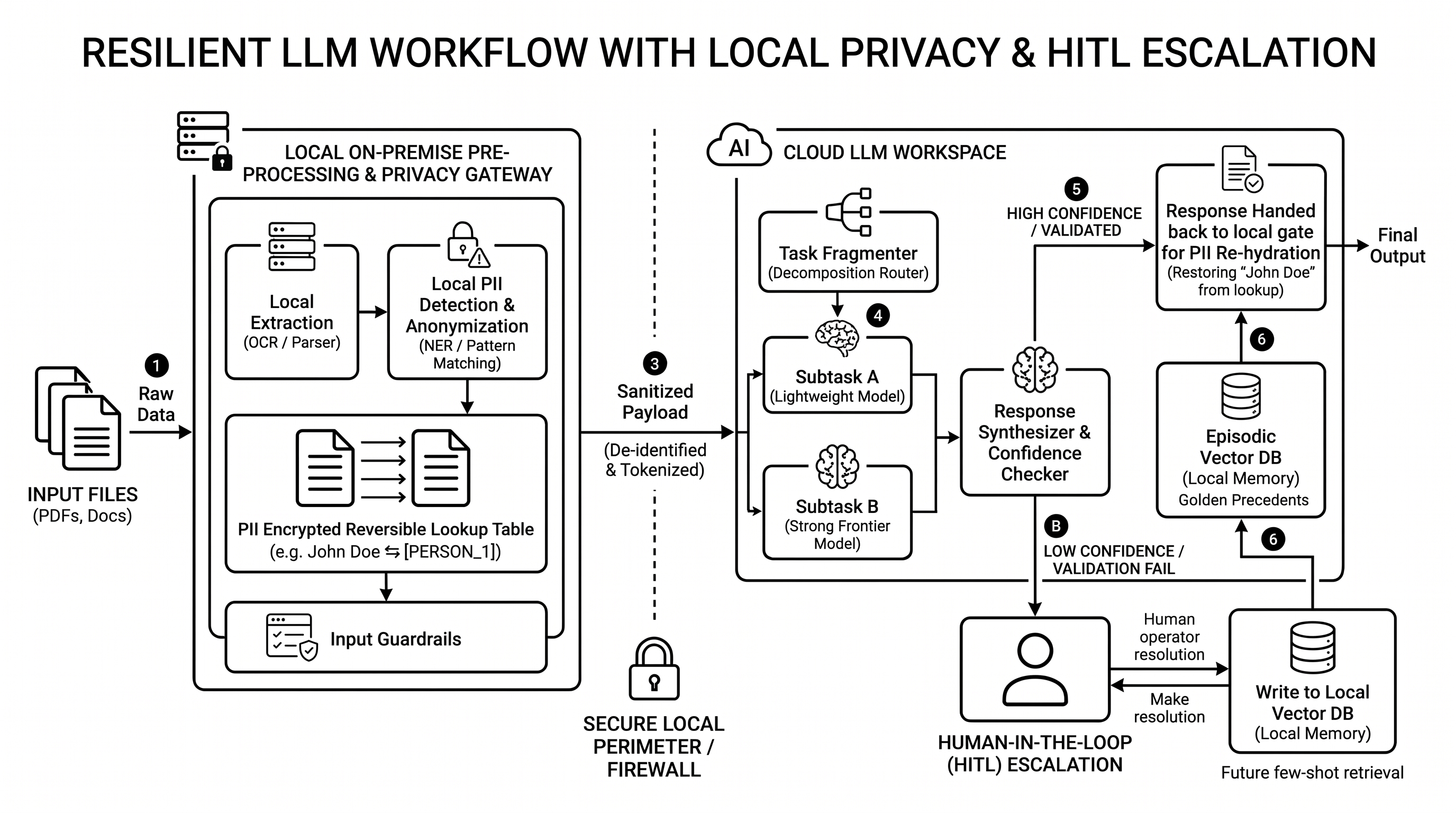
Before any data ever reaches an external model, the architecture must establish strict guardrails and local user privacy through automated data anonymization. Sending raw customer documents, contracts, or support tickets directly to third-party cloud LLM APIs introduces severe compliance risks and potential data leakage. To prevent this,a local pre-processing gateway should intercept and sanitize all incoming files—such as PDFs, Word documents, or spreadsheets—entirely on-premise before making an outbound API call. In practice, this local pipeline begins with deterministic text extraction (using libraries like pdfplumber, PyMuPDF, or local OCR engines like Tesseract for scanned pages) to convert raw files into plain text. Next, a lightweight, locally hosted Named Entity Recognition (NER) and pattern-matching engine—such as Microsoft Presidio paired with a local spaCy model—scans the extracted text to detect Personally Identifiable Information (PII), including customer names, phone numbers, tax IDs, and physical addresses. Rather than permanently destroying context, the local gateway replaces sensitive entities with consistent, reversible surrogate tokens (for example, swapping "John Doe" with [PERSON_1] and storing the mapping in an encrypted, short-lived local lookup table). Only this scrubbed payload is transmitted to the cloud LLM, and once the model returns its response, the local gateway re-hydrates the surrogate tokens back into real values for internal use or human review. Pairing this local anonymization layer with input/output guardrails—which block prompt injections on the way in and enforce strict schema and policy compliance on the way out—ensures that cloud intelligence can be leveraged safely without exposing sensitive user data.
Once sanitized data enters the reasoning pipeline, the next architectural pillar is task fragmentation paired with tiered model routing. When a single prompt asks a model to interpret ambiguous context, apply complex business rules, and format a final decision all at once, the model's cognitive load spikes and error rates climb. Breaking that monolithic prompt into smaller, single-responsibility steps allows each stage to focus on a narrower problem, which immediately improves predictability. More importantly, fragmentation enables intelligent model selection. Not every step requires a frontier model, yet relying exclusively on lightweight models for complex reasoning often triggers multiple failed attempts and corrective API calls. Routing difficult subtasks to a stronger, more expensive model frequently proves both faster and more economical in the long run, because a capable model resolves the task in a single pass rather than burning tokens across several retries. At the same time, architects must guard against compounding error rates across long chains; if five sequential steps each succeed ninety-five percent of the time,overall pipeline reliability drops below eighty percent. Fragmentation works best when each boundary serves a clear purpose, such as isolating a distinct reasoning mode or inserting a validation check.
The third pillar is using a local vector database as episodic memory. Statically stuffing every possible edge case into a system prompt quickly exhausts context windows and degrades model attention. Instead, storing historical,anonymized task outcomes in a local vector database allows agents to retrieve only the most relevant past precedents before making a new decision. In effect, this creates a dynamic few-shot prompting mechanism. When an agent sees how a closely related case was previously resolved, ambiguity shrinks and decision confidence rises. However, the value of episodic memory depends entirely on strict write discipline. If an agent saves its own unverified, medium-confidence guesses back into the database, future queries will retrieve those flawed outputs and reinforce hallucinations over time. To prevent memory poisoning, only outcomes that have passed deterministic validation checks or received human approval should be committed to the vector store, ideally paired with metadata filters so agents retrieve precedents that share the same business rules rather than mere surface-level text similarity.
The fourth pillar is human-in-the-loop (HITL) escalation as a safety net and learning mechanism. No autonomous system achieves perfection across every novel edge case, and forcing an LLM to guess when uncertain is the fastest way to erode user trust. Treating low confidence as an explicit routing signal ensures that ambiguous or high-risk decisions are handed off to a human operator before any real-world action is taken. Crucially, this escalation step does more than prevent errors; it closes the system's learning loop. When a human resolves an escalated edge case and that verified, anonymized resolution is written back into the vector database, the system permanently expands its institutional knowledge. Over time, recurring edge cases become familiar precedents, and the rate of human intervention steadily declines.
Of course, the effectiveness of both model escalation and human handoff hinges on how confidence is measured.Asking an LLM to self-report its certainty on a numerical scale rarely works in practice, as models frequently assign high confidence scores to fabricated answers. Reliable architectures anchor confidence in structural and statistical signals instead. Inspecting token log probabilities on key classification outputs, running lightweight models multiple times to check whether independent samples reach consensus, or enforcing deterministic schema and rule-engine checks all provide far more trustworthy triggers than self-evaluation alone.
Taken together, these architectural choices transform an unpredictable probabilistic model into a disciplined engineering pipeline. Local anonymization and guardrails protect user privacy before data leaves the perimeter, task fragmentation keeps reasoning focused and optimizes API spend, episodic vector memory grounds new decisions in proven historical precedents, and human-in-the-loop escalation protects against edge cases while continuously teaching the system to handle them autonomously in the future.
November 15, 2026