And if so, will programming languages as such disappear (because AI can directly convert natural language into binary machine code)?
Neither outcome is inevitable, and both face severe economic, physical, and formal-logic barriers. While artificial intelligence will rewrite and maintain a massive share of software, existing human codebases and formal programming languages will persist as structural necessities rather than historical relics.
Regarding whether all human-written codebases will be rewritten, a large portion of active, evolving code will certainly be refactored, translated, or replaced by AI-assisted workflows, especially where legacy technical debt blocks business agility. However, a universal rewrite will not happen because of what might be called the specification trap. Legacy codebases are not merely syntax; they are the accumulated record of decades of edge cases, regulatory patches, hardware quirks, and undocumented business rules. An AI cannot safely rewrite a system unless it has a complete, unambiguous specification of what that system does, and in most legacy systems, the code itself is the only complete specification available.
Economics and liability reinforce this barrier. Rewriting functioning, stable software carries massive verification costs and operational risk for zero new business value. Core banking systems, aviation firmware, and telecom switches still run decades-old COBOL, C, and Ada not because humans lacked the ability to rewrite them, but because the cost of proving behavioral equivalence outweighs the benefit. Furthermore, in safety-critical and regulated industries such as aerospace, medical devices, automotive, and finance, every line of code is tied to formal verification, audit trails, and legal accountability. Probabilistic generation without deterministic, auditable intermediate representations simply fails regulatory certification.
As for whether programming languages will disappear in favor of direct compilation from natural language to machine code, the answer is also no. Even if an AI could compile English directly into x86 or ARM binary with zero syntax errors, formal intermediate languages would remain indispensable—or be reinvented under a different name. Natural language is inherently ambiguous, context-dependent, and underspecified, whereas programming languages exist precisely to eliminate ambiguity. If you prompt an AI to build a fast, secure ledger, two separate runs can produce subtly different locking semantics, precision handling, or failure modes. To make natural language precise enough to specify complex systems reliably, you inevitably end up writing formal specifications, which are themselves programming languages.
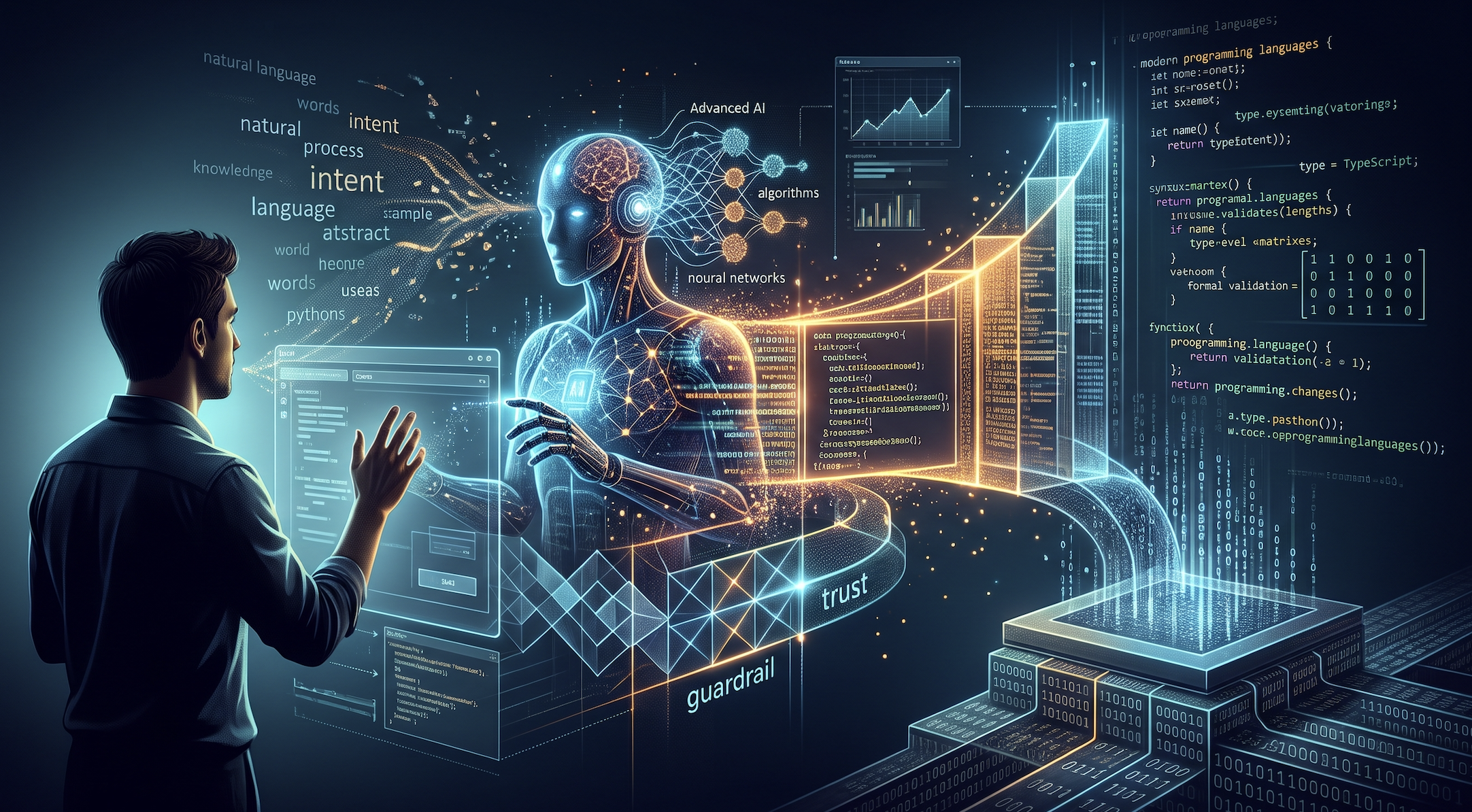
Verification, debugging, and computational efficiency also require intermediate code. Compiling directly from natural language to raw machine code creates an opaque black box. When a system fails in production, develops a subtle race condition, or requires a security audit, neither humans nor AI can efficiently reason about millions of raw assembly instructions without higher-level structural abstractions like types, modules, interfaces, and invariants. Tokenizing and verifying structured code is also orders of magnitude cheaper, faster, and more deterministic than having a large language model synthesize raw binary opcodes from scratch. In practice, AI acts as a new, higher-level compiler layer sitting above existing languages—translating human intent into TypeScript, Rust, Python, or SQL, which then pass through deterministic compilers and type checkers to guarantee memory safety, type soundness, and predictable execution.
Rather than disappearing, programming languages are shifting their primary audience. Historically, languages were designed for human ergonomics, prioritizing readability, boilerplate reduction, and expressive syntax. Going forward, languages and tooling will increasingly optimize for machine verifiability and constraint enforcement, relying on strong static type systems, formal contracts, and sandboxed execution environments that act as guardrails to catch AI hallucinations before code ever reaches production.
November 25, 2026